
The best exterior drainage solutions to prevent flooding include French drains, yard grading improvements, channel drains, downspout extensions, dry wells, and retaining wall drainage systems. The most effective approach is not a single system but a coordinated drainage design that manages surface water, groundwater, and roof runoff together.
In real-world construction, flooding issues almost always stem from multiple small failures rather than a single obvious defect. Water follows the path of least resistance, and when that path is poorly controlled, it leads to pooling, erosion, and long-term foundation stress.
Why Exterior Drainage Is Essential for Property Protection
Water is one of the most damaging forces affecting residential structures. When unmanaged, it gradually undermines soil stability, increases hydrostatic pressure against foundations, and leads to cracking, settling, and moisture intrusion.
In many exterior drainage in Richmond, VA projects, the root cause is not visible until soil excavation or grading analysis reveals improper slope conditions beneath landscaping layers or hardscape installations.
At Tiger C Construction, LLC, drainage evaluations focus on mapping real water movement patterns during rainfall rather than surface-level symptoms after storms.
Common Causes of Exterior Water Problems
- Reverse or flat grading that traps water near structures
- Downspouts discharging too close to foundations
- Clay-heavy soil limiting infiltration
- Blocked or undersized drainage systems
- Hydrostatic pressure buildup along foundation walls
- Low points in landscaping that collect runoff
For example, during a recent inspection in The Fan, recurring basement moisture was traced to subtle grading inconsistencies hidden beneath older lawn renovations.
Early Warning Signs
- Standing water lasting more than 24 hours
- Soil erosion near walkways or patios
- Basement dampness or odor
- Visible foundation cracking
- Mulch or soil displacement after storms
- Soggy lawn areas that never fully dry
Best Exterior Drainage Solutions to Prevent Flooding
French Drain Systems
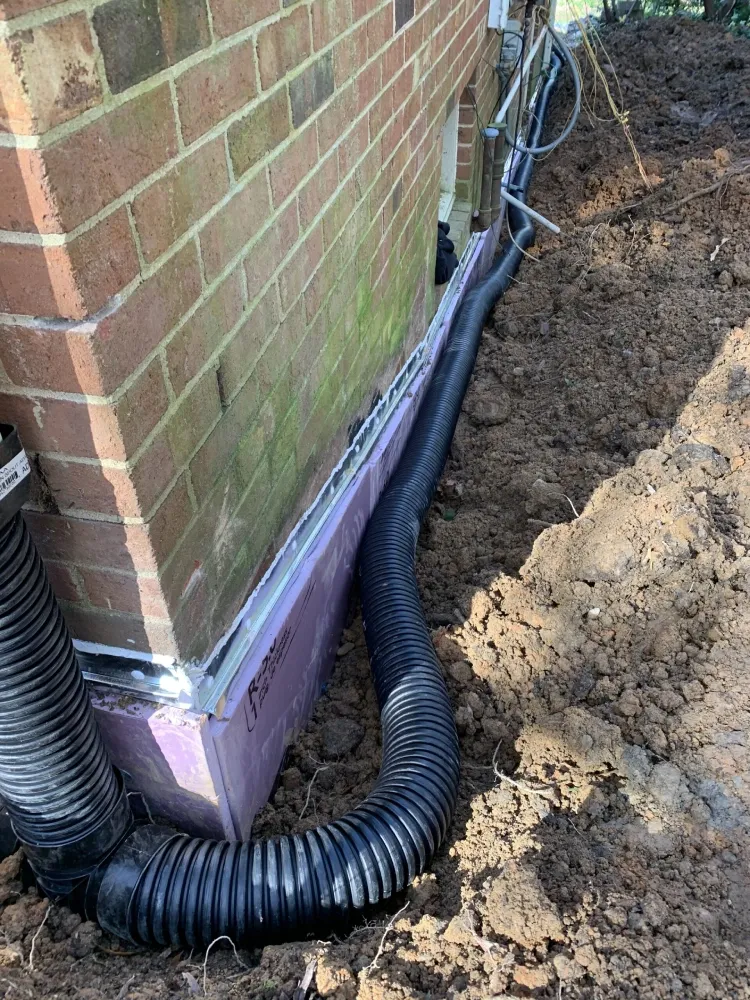
French drains are one of the most reliable subsurface drainage solutions for managing groundwater. They consist of perforated piping installed within gravel trenches that redirect water away from critical structures.
They are especially effective when dealing with saturated soil conditions that cannot be resolved through surface grading alone.
Best applications:
- Foundation perimeter protection
- Basement moisture reduction
- Retaining wall drainage relief
- Saturated yard sections
Proper slope calculation is essential; even small installation errors can significantly reduce system performance.
Channel Drains for Surface Water Control
Channel drains are designed to capture water flowing across hard surfaces before it accumulates or enters structures. They are commonly used in high-runoff areas where rapid water removal is required.
Ideal use cases:
- Driveways with slope runoff
- Patios and pool decks
- Garage entrances
- Commercial walkways
Unlike subsurface systems, channel drains handle visible surface flow during heavy rainfall events.
Downspout Extensions and Roof Runoff Management
Roof runoff is one of the most underestimated contributors to exterior flooding. Even moderate rainfall can generate thousands of gallons of water runoff from a single roof system.
Improper discharge often results in repeated soil saturation around foundations.
In Church Hill, a drainage correction project identified short downspout discharge as the primary driver of repeated perimeter flooding.
Best practice:
Extend downspouts at least 6–10 feet away from the structure when site conditions allow.
Yard Grading and Surface Flow Correction
Grading is the foundation of any effective drainage system. If water is not naturally directed away from a structure, other drainage components must work significantly harder to compensate.
In many cases of exterior drainage in Richmond, grading issues are the underlying cause, even when drainage systems appear to be functioning correctly.
Standard grading guideline:
- Minimum slope of ~6 inches over the first 10 feet away from structures
- Continuous positive drainage away from foundations
- Elimination of low points that collect runoff
Proper grading ensures the long-term performance of all other drainage components.
Dry Wells for Subsurface Water Management
Dry wells collect runoff and slowly disperse it into the surrounding soil layers. They are useful in properties where direct stormwater outlets are not available.
Best suited for:
- Isolated runoff collection points
- Moderate rainfall environments
- Properties without municipal drainage access
System sizing and soil permeability directly impact performance.
Retaining Wall Drainage Systems
Retaining walls require engineered drainage systems to relieve hydrostatic pressure buildup. Without proper drainage, water trapped behind walls can cause structural failure over time.
Key components include:
- Perforated drain pipe
- Clean gravel backfill
- Filter fabric to prevent clogging
- Weep holes for pressure release
These systems must be installed during construction for maximum effectiveness.
Comparison of Exterior Drainage Solutions
| System | Function | Best Use | Maintenance | Lifespan |
| French Drain | Groundwater control | Foundations | Low | 20–30 yrs |
| Channel Drain | Surface water capture | Hardscapes | Moderate | 15–20 yrs |
| Downspout Extension | Roof runoff control | Perimeter protection | Low | 10–15 yrs |
| Yard Grading | Water redirection | Whole property | Very low | Long-term |
| Dry Well | Water dispersion | Isolated runoff | Moderate | 15–25 yrs |
| Retaining Wall Drainage | Pressure relief | Sloped sites | Low | 20+ yrs |
How to Choose the Right Drainage System
Every property requires a tailored approach based on elevation, soil conditions, and water flow behavior.
Step-by-step evaluation process:
- Identify water accumulation zones after rainfall
- Evaluate grading and slope direction
- Inspect roof runoff discharge paths
- Analyze soil absorption characteristics
- Identify structural risk areas
- Combine multiple drainage methods when necessary
- Design for long-term stormwater control rather than temporary relief
A properly engineered system almost always includes multiple drainage solutions working together.
Drainage System Specifications and Features
French Drain
A subsurface trench system that uses perforated pipe and gravel to redirect groundwater.
- Depth: 18–36 inches
- Function: groundwater interception and diversion
- Pipe: perforated PVC or corrugated pipe
Channel Drain
A surface drainage system designed to collect fast-moving water across hard surfaces.
- Function: surface runoff capture
- Installation: flush with the ground surface
- Material: polymer concrete, plastic, or steel
Dry Well
An underground chamber used to temporarily store and slowly release stormwater.
- Function: runoff absorption and dispersion
- Performance depends on soil permeability
- Common in limited drainage environments
Applying Our “FloodShield Method” to Solve Drainage Issues
At Tiger C Construction, LLC, drainage solutions are designed using a structured methodology focused on root cause elimination rather than surface repair.
1. Water Flow Mapping
Drainage patterns are analyzed during real rainfall conditions.
2. Soil Performance Analysis
Soil type determines how quickly water is absorbed or retained.
3. System Integration Design
Drainage components are engineered to work together as a unified system.
4. Long-Term Performance Planning
Systems are designed for durability, maintenance efficiency, and seasonal weather conditions.
Common Misconceptions About Drainage Systems
Myth: One Drain Fixes All Flooding Problems
This is incorrect in most real-world scenarios.
Flooding is typically caused by multiple interacting factors such as grading, soil saturation, and roof runoff concentration. Installing a single system rarely solves the entire issue.
For example, in a Richmond, VA, exterior drainage project, flooding persisted even after drain installation because the surrounding grading still directed runoff toward the structure.
Effective solutions require layered drainage design.
Why Proper Drainage Design Matters
Drainage systems must account for:
- Water volume during peak storms
- Soil saturation limits
- Structural load conditions
- Long-term erosion risks
Without proper design, even high-quality systems can fail prematurely.
Material Quality and Long-Term Performance
Durability depends heavily on installation materials such as:
- Washed drainage gravel
- High-quality filter fabric
- Properly rated piping systems
Inferior materials often lead to clogging, sediment buildup, and reduced flow capacity over time.
Signs It’s Time to Upgrade Drainage Systems
- Repeated pooling after rainfall
- Foundation dampness or leakage
- Soil erosion near structures
- Cracked concrete or masonry
- Persistent wet landscaping areas
Early intervention prevents costly structural repairs.
In Summary
The most effective exterior drainage solutions to prevent flooding include French drains, grading improvements, channel drains, downspout extensions, dry wells, and retaining wall drainage systems. In most cases, the strongest protection comes from combining multiple systems designed around actual water movement patterns.
If your property is experiencing recurring water issues, Tiger C Construction, LLC can design a customized solution built for long-term performance and structural protection.
Contact us today to schedule a professional drainage evaluation and address water issues before they escalate into costly damage.
People Also Ask
What is the most effective exterior drainage system?
French drains are highly effective for controlling groundwater and reducing foundation pressure.
Can exterior drainage prevent basement leaks?
Yes, when properly designed, exterior drainage reduces water pressure against foundation walls.
How long do drainage systems last?
Most systems last 15–30 years, depending on installation quality and maintenance.
What causes yard flooding?
Common causes include poor grading, compacted soil, and inadequate drainage pathways.
Do I need more than one drainage system?
Yes, layered drainage systems typically perform better than single solutions.